

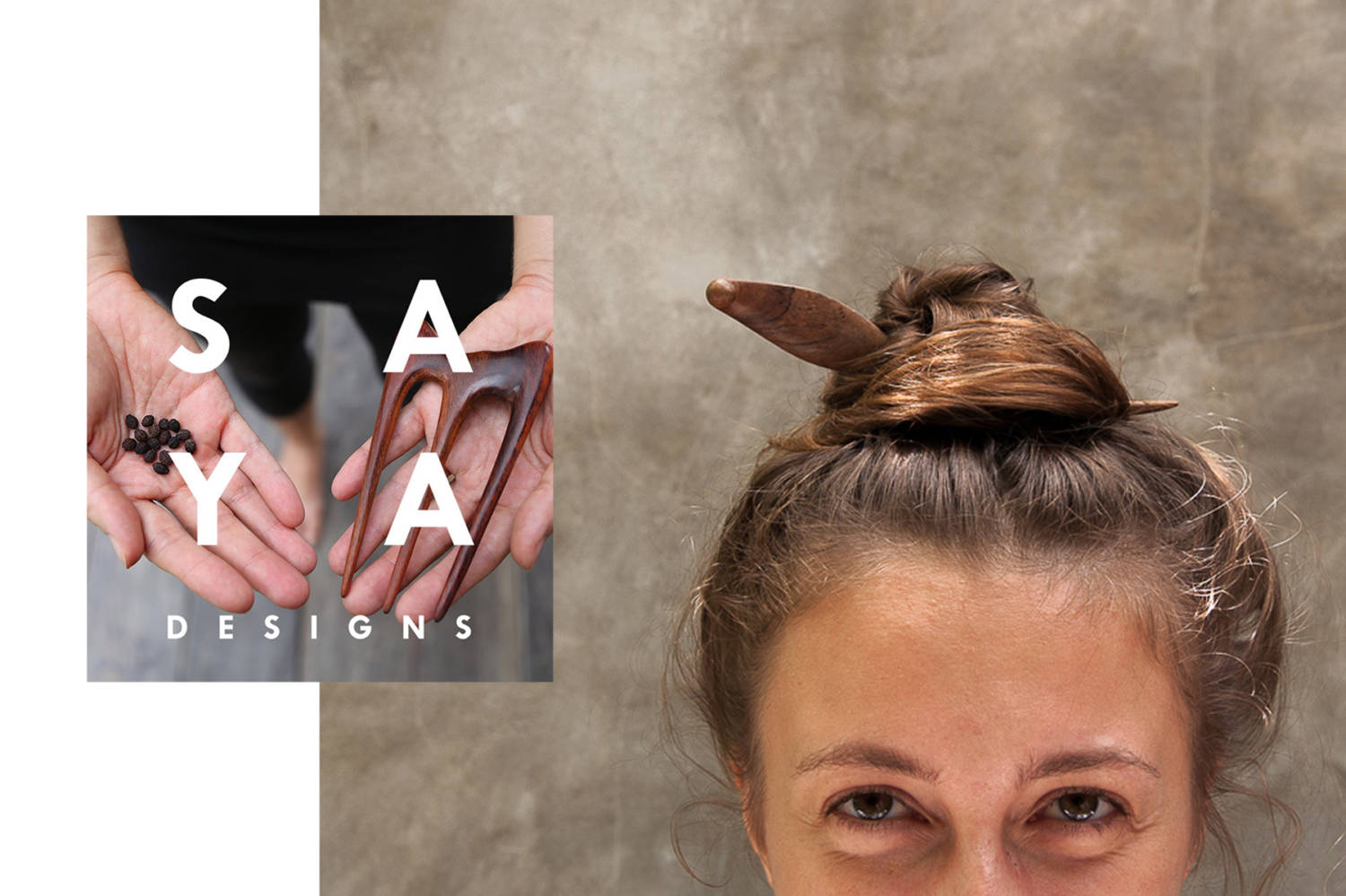
When you delve into environmental protection, you quickly realize there are countless areas where you can make a difference. One issue particularly close to British entrepreneur Victoria's heart is deforestation. With SAYA Designs, she founded a company that combats deforestation, combining her love of nature, a growing awareness of environmental issues, and the desire to create unique products. In this interview, she tells us about the values that drive her and how she came up with the idea of making hairpins from waste wood.
The idea originated over two years ago when I left England to live and work in Bali. During my first few months on the island, I became increasingly affected by the environmental problems surrounding me. Further research led me to visit several forestry projects, attend sustainability conferences, and meet with local artisans—all to gain a deeper understanding of the incredibly important issue of deforestation. This has repercussions on both a global and local level, and we urgently need to pay more attention to it.
At the same time, I learned about the concept of the 'circular economy' and how it differs from our current economic model. I realized that I wanted to become self-employed in order to be part of this concept and thus advocate for the issues that had become so important to me.
So why hairpins? I've worn and admired them for years. When I had to decide what to design, I wanted something small enough to be easily shipped, practical, and unique. After putting all the pieces together, SAYA was born!
The production of the hairpins is based on the three principles of the 'Circular Economy':
Recycle | Repurpose | Replenish
Recycle:
Wood is only a sustainable material if it is also sourced sustainably. Tropical hardwoods grow very slowly and sparsely. Unfortunately, these species are still often illegally and far too extensively logged because of their value. During my research, I met Made & Wayan, two sculptors who dig up and recycle roots on old Indonesian plantations. These roots were left behind by loggers and have very little nutritional value for the soil.
Repurpose:
Hairpins have been used for a very long time; they hold a special place in many ancient cultures and are a plastic-free alternative to hair ties. SAYA hairpins are inspired by Indonesian flora and fauna in their design and are handcrafted by Balinese artisans.
Replenish:
To close the loop of the circular economy, up to 10 endangered tree species are planted for every hairpin sold. For this, we have partnered with the organization GAIA, which works with local communities throughout Indonesia.
The finished hairpin is then packaged and shipped locally in Bali in a workshop that employs women to give them the same opportunities as men. This creates new jobs in Indonesia.
For me, SAYA is a means to research and advance environmental protection, while simultaneously offering the opportunity to encourage others to do the same. Through SAYA, we want to awaken interest and enthusiasm for these issues and invite others to take action. I want to develop SAYA into a platform that champions this beautiful planet and its people.
At SAYA, we take a waste product and transform it into something beautiful and useful. The opportunity to directly support local artisans and thus NGOs and ethically working individuals is an incredibly powerful privilege in times of globalization, industrialization, and climate change. I believe we are very close to real change, and I am personally committed to dedicating all my energy to bringing about that change.
Planting trees is one of the best ways to combat climate change-related problems such as soil erosion, environmental degradation, rising average temperatures, low rainfall, and increased CO2 emissions. Our partner organization, GAIA, is headquartered in Jakarta and has two additional offices in Puncak and Lombok. They work with various communities in Indonesia, educating the population about the problem of deforestation. They also collaborate with major organizations like the FFI and engage with government officials to promote socially responsible forest management. The trees we support through SAYA sales are endemic species planted in the forests of Rinjani National Park.
SAYA means 'I' and 'my' in Indonesian. It depends on how the sentence is structured. So SAYA Designs means 'my designs'. I liked the word and the fact that it's directly associated with Indonesia.
One of the most important things I've been thinking about lately in connection with sustainability is simply the fundamental concept of 'wanting less'.
SAYA uses recycled wood and materials, but the hairpins themselves are made from hardwoods that take an incredibly long time to grow. The core idea behind SAYA is to talk about and inform people about this slow process, about how special these woods are, and about how we need to reduce our consumption to truly appreciate their value.
Wanting less, but loving what we have, is very important when it comes to sustainability, because we are constantly moving further and further away from the basic idea we need.
*The interview was first conducted in English and then translated into German.
1. Dear Victoria, first of all, tell us how the idea for SAYA Designs came about and why you decided to start your own business in Indonesia?
The idea originated over two years ago when I left England to live and work in Bali. During my first few months on the island, I became increasingly affected by the environmental problems surrounding me. Further research led me to visit several forestry projects, attend sustainability conferences, and meet with local artisans—all to gain a deeper understanding of the incredibly important issue of deforestation. This has repercussions on both a global and local level, and we urgently need to pay more attention to it.
At the same time, I learned about the concept of the 'circular economy' and how it differs from our current economic model. I realized that I wanted to become self-employed in order to be part of this concept and thus advocate for the issues that had become so important to me.
So why hairpins? I've worn and admired them for years. When I had to decide what to design, I wanted something small enough to be easily shipped, practical, and unique. After putting all the pieces together, SAYA was born!
2. Would you like to give us a brief insight into the production of the hairpins? What stages do they go through on their way to becoming a finished hairpin?
The production of the hairpins is based on the three principles of the 'Circular Economy':
Recycle | Repurpose | Replenish
Recycle:
Wood is only a sustainable material if it is also sourced sustainably. Tropical hardwoods grow very slowly and sparsely. Unfortunately, these species are still often illegally and far too extensively logged because of their value. During my research, I met Made & Wayan, two sculptors who dig up and recycle roots on old Indonesian plantations. These roots were left behind by loggers and have very little nutritional value for the soil.
Repurpose:
Hairpins have been used for a very long time; they hold a special place in many ancient cultures and are a plastic-free alternative to hair ties. SAYA hairpins are inspired by Indonesian flora and fauna in their design and are handcrafted by Balinese artisans.
Replenish:
To close the loop of the circular economy, up to 10 endangered tree species are planted for every hairpin sold. For this, we have partnered with the organization GAIA, which works with local communities throughout Indonesia.
The finished hairpin is then packaged and shipped locally in Bali in a workshop that employs women to give them the same opportunities as men. This creates new jobs in Indonesia.
3. Share your "why" with us: Why did you start SAYA Designs and what values underlie your company?
For me, SAYA is a means to research and advance environmental protection, while simultaneously offering the opportunity to encourage others to do the same. Through SAYA, we want to awaken interest and enthusiasm for these issues and invite others to take action. I want to develop SAYA into a platform that champions this beautiful planet and its people.
At SAYA, we take a waste product and transform it into something beautiful and useful. The opportunity to directly support local artisans and thus NGOs and ethically working individuals is an incredibly powerful privilege in times of globalization, industrialization, and climate change. I believe we are very close to real change, and I am personally committed to dedicating all my energy to bringing about that change.
4. For every hairpin sold, up to 10 endangered tree species are planted in Indonesia. Can you tell us a little more about that?
Planting trees is one of the best ways to combat climate change-related problems such as soil erosion, environmental degradation, rising average temperatures, low rainfall, and increased CO2 emissions. Our partner organization, GAIA, is headquartered in Jakarta and has two additional offices in Puncak and Lombok. They work with various communities in Indonesia, educating the population about the problem of deforestation. They also collaborate with major organizations like the FFI and engage with government officials to promote socially responsible forest management. The trees we support through SAYA sales are endemic species planted in the forests of Rinjani National Park.
5. What does the name SAYA stand for?
SAYA means 'I' and 'my' in Indonesian. It depends on how the sentence is structured. So SAYA Designs means 'my designs'. I liked the word and the fact that it's directly associated with Indonesia.
6. What are your personal tips for more sustainability in everyday life?
One of the most important things I've been thinking about lately in connection with sustainability is simply the fundamental concept of 'wanting less'.
SAYA uses recycled wood and materials, but the hairpins themselves are made from hardwoods that take an incredibly long time to grow. The core idea behind SAYA is to talk about and inform people about this slow process, about how special these woods are, and about how we need to reduce our consumption to truly appreciate their value.
Wanting less, but loving what we have, is very important when it comes to sustainability, because we are constantly moving further and further away from the basic idea we need.
*The interview was first conducted in English and then translated into German.















Leave a comment
This site is protected by hCaptcha and the hCaptcha Privacy Policy and Terms of Service apply.