



1. On average, every German throws away 80 kg of food per year.
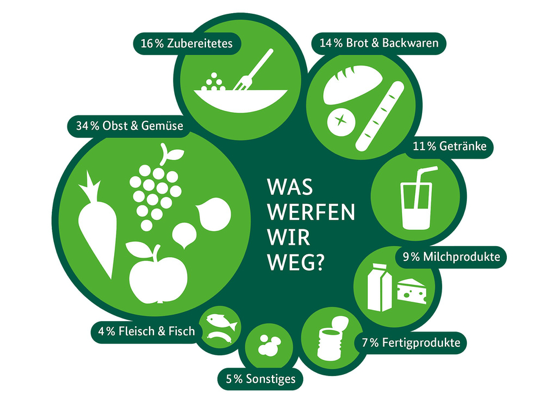
80 kg – that's the equivalent of throwing away 160 packages of rolled oats or 750 apples. As the graphic (based on the "Too Good to Waste" initiative ) shows, it's actually fruits and vegetables that are most frequently thrown away in private households. Prepared meals and baked goods follow in percentage terms. The reasons why food is discarded vary, but ultimately, it's food that ends up in the bin. Significantly less food would be wasted if more people were better informed about shelf life, proper food storage, and the various terms used on packaging – which brings us to the next point...2. It is not illegal to sell expired goods.
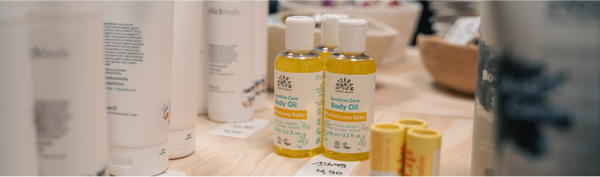
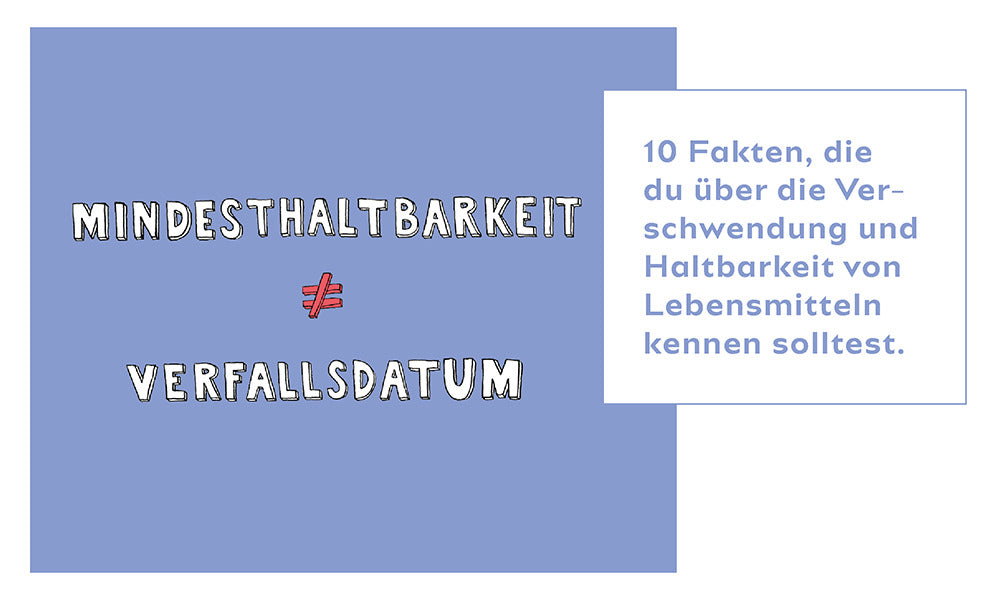
Generally speaking, selling food past its best-before date is not prohibited in Germany. A fundamental distinction must be made between the best-before date and the use-by date. Food past its best-before date may still be sold. However, food past its use-by date, such as fresh meat or fish, may not. You can find more information on this topic, for example, here . Our shop concept is based, among other things, on raising awareness of this issue as a society and preventing perfectly good products from being unnecessarily thrown away. Of course, we don't offer any food in our shop that is no longer fit for consumption. For this very reason, some of these products get a second chance in our shop . Did you know that cosmetics and medications also have best-before dates? I personally wasn't aware of this, especially with cosmetics, until recently. I wasn't aware that so many products in this area have a best-before date, and that as a result, so much is thrown away and disposed of.3. Proper food storage is invaluable.
Many foods in private households spoil too quickly because they are not stored properly. Fruits and vegetables, nuts, and baked goods, in particular, can be stored much longer in your kitchen with proper storage, preventing unnecessary waste. This saves resources and money.For example, you can easily freeze leftover bread in slices and quickly toast them when needed. Wrinkled carrots will become crisp again in a glass of water, and fresh herbs will keep longer wrapped in damp cloths. Find more great tips here !
4. Some foods, such as canned goods, rice, or cocoa powder, can last for years beyond their best-before date.
As explained in the second point, many foods keep much longer – some even up to a year beyond their best-before date! Don't be misled by the date on the packaging. The best tip here: Trust your own senses ! Take a close look at the butter, bread, or cheese, and do a smell and taste test.
Dry products such as flour, spices, tea or legumes, in particular, can be stored almost indefinitely in a dry and dark place.
In our shop, you'll find, for example , a wide variety of Koawach organic cocoa, as well as bars, pralines, and chocolate tablets from Lovechock. The cocoa has passed its best-before date, but it still tastes just as delicious and wakes you up just as well ;) . The Lovechock treats are also nearing their best-before date – but that doesn't change their taste at all. Of course, we tested the chocolates beforehand for taste, texture, and appearance.
5. "Prepared foods have the largest ecological footprint"
This is explained by Gerold Hafner, who led a study on food waste in Germany commissioned by the Federal Ministry of Food and Agriculture (more information about the study can be found here ). When ready-made products are sold, resources and energy have already been consumed in their production. If the end consumer, i.e., us private individuals, then disposes of such a ready-made product, they are wasting this energy.
Therefore, it's better to buy regional products whenever possible and prepare meals fresh at home.
6. Food spoilage can be delayed.
There are countless methods to make food last longer; the key term here is preservation .
You probably already know that you can easily put food in the freezer and thaw it when needed. The food industry also uses this method – just think of frozen pizza and the like. Fruit can be made into compote by cooking it down. Salting, drying, and sugaring are age-old ways to preserve food and, of course, still work today.
7. It's perfectly fine if the bakery counter isn't fully stocked in the evening.
After work or a long day at university, you quickly pop into your favorite bakery or the supermarket around the corner, and then – disappointment: empty counters and stripped shelves. A little food for thought is needed here: it's much better if stores ensure that goods are bought up throughout the day. Otherwise, everything left over after closing time often ends up in the trash.
So don't be annoyed if you don't find the largest selection of baked goods or similar items shortly before closing time, because that means that the respective retailer has thought about it and wants to avoid excess stock.
8. Targeted shopping saves food.
Heading off to the supermarket hungry and without a plan? You should avoid doing that if possible. Because when you're ravenous and don't have a shopping list, you usually end up with not only numerous snacks but also items in your basket or tote bag that you can't really use up at home. So before you leave the house in the morning or go shopping, take a look at what's in your fridge and which items need to be used up.It's best to write yourself a shopping list and stick to it in the store. Also, as an individual, avoid special offers such as giant family packs or supposed "buy 3, pay for 2" bargains.
9. You can save food via app.
Too Good To Go is the app that lets you easily see what food is left over in your area in the evening. Participating businesses include bakeries, but also restaurants and fast-food chains. The app shows you what's available nearby. You can then reserve your meal or snack from home and pick it up at a discounted price within a specified time window at the respective establishment.
Another platform fighting food waste is Foodsharing. Click here and become part of the rescue movement! :)
10. Our waste and surplus of food in Germany contributes to a global scarcity of resources.
The low value placed on and waste of goods here in Germany has global repercussions. If certain foodstuffs are to be constantly available in very large quantities in Germany, our domestic arable land will no longer be sufficient. This means that grain and other raw materials will have to be imported, driving up prices on the world market. As a result, resources become more expensive and scarcer overall.Appreciation of food and mindful consumption
These 10 facts ultimately lead to two resolutions that we can all take to heart, indeed, absolutely must.Food production involves resources, energy, and labor. Therefore, it should be self-evident that goods are offered at correspondingly high prices, and that an abundance of food is not the norm.
We have a responsibility to give food the appreciation it deserves. We cannot be wasteful with it, but must – if we haven't already – internalize the mindful consumption of food.
Sources:
https://www.zeit.de/wissen/2019-05/lebensmittelverschwendung-haushalte-essen-muell-deutschland
https://www.verbraucherzentrale.de/wissen/lebensmittel/auswaehlen-zubereiten-aufbewahren/lebensmittel-zwischen-wertschaetzung-und-verschwendung-6462
http://www.tafel.de/themen/nachhaltigkeit/mhd/



























































Leave a comment
This site is protected by hCaptcha and the hCaptcha Privacy Policy and Terms of Service apply.