

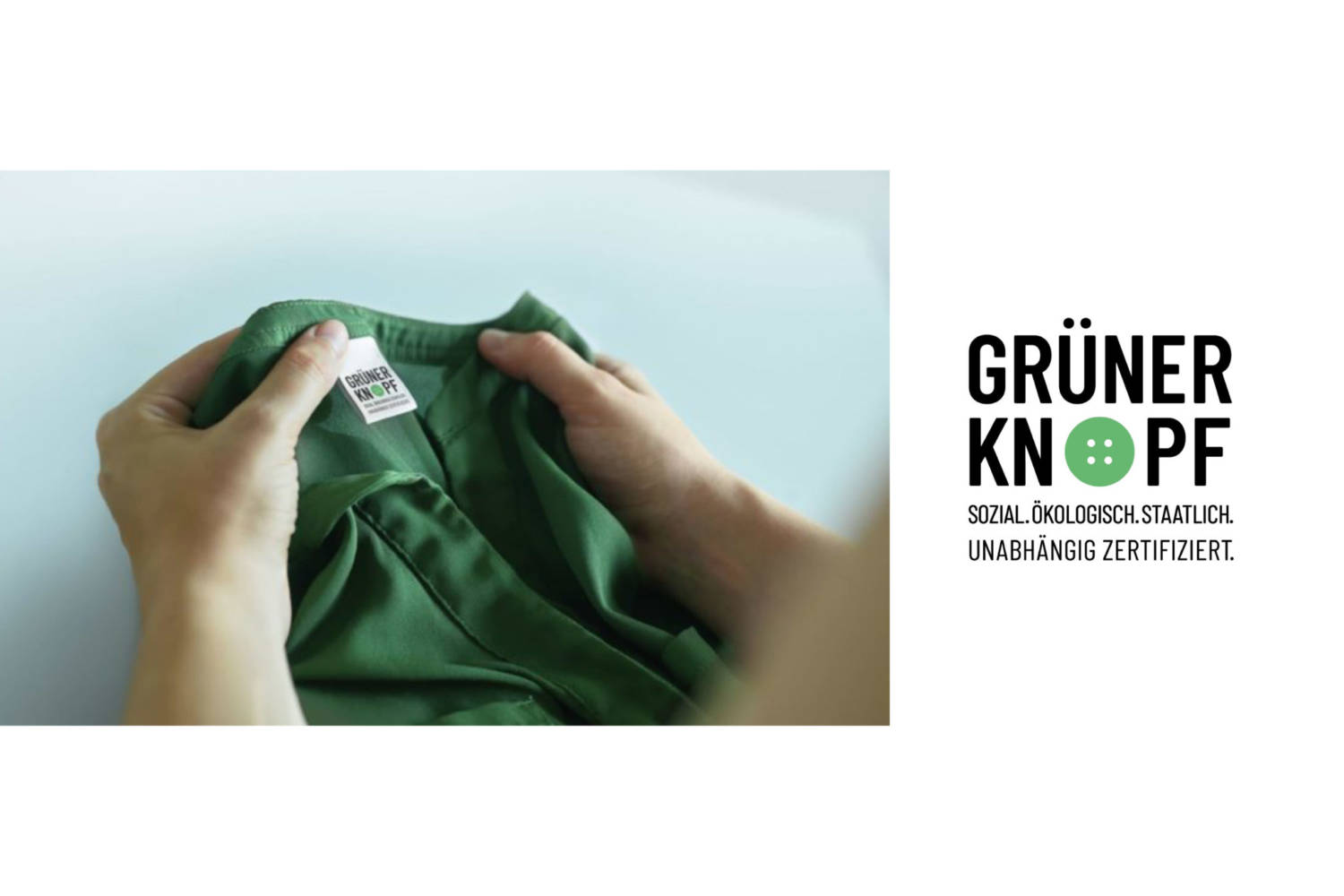
After a long planning phase, the first state-run textile label, the "Green Button," was presented by Federal Development Minister Gerd Müller at the beginning of September. It is intended to identify textiles produced in a socially and ecologically responsible manner. We will not only provide you with the most important information about the Green Button, but also present two opinions from textile industry experts, each offering a different assessment of the Green Button.
The Green Button is a national quality label for compliance with ecological and social textile standards. What makes it special is that it is the first government-backed label for sustainable textiles and, unlike other labels, combines the two aspects of environmental and social responsibility. A company is assessed against 46 standards and then certified for three years by accredited testing bodies. It is also possible for only individual products within a company to be certified. Furthermore, any company that already holds one of the other recognized labels (such as the GOTS label) can be certified with the Green Button without further assessment.
During the introductory phase, which lasts until June 2021, only the production stages of "cutting and sewing" and "bleaching and dyeing" will initially be inspected. The plan is to cover the entire supply chain and refine the criteria in the coming years. Brands such as Hessnatur, Vaude, as well as Aldi and Tchibo, are already certified.
But do we really need another label? And how are we supposed to keep track of them all? The Federal Ministry for Economic Cooperation and Development (BMZ) aims to differentiate itself from other labels by presenting the Green Button as a guide that covers all facets of sustainable production.
Of course, as with many other things, there is also criticism of labels. It's difficult to say to what extent labels create transparency, because there are so many labels that it's easy to lose track of all the standards. The German Textile and Fashion Association also considers an additional national label superfluous, as there are already many internationally recognized labels. Furthermore, all labels are voluntary, which means that the responsibility shifts from companies to consumers. Consequently, there are increasing calls for a legally mandated label. It's particularly unfortunate that the Green Button, after a five-year planning phase, contains so little substance. For example, currently only the payment of the respective country's minimum wage is a criterion. This is generally not enough to live on. Actual living wages are only supposed to become a criterion in the coming years.
We also wanted to know what motivates companies to get certified and what their general attitude is towards sustainability labels. To find out, we spoke with two of our partner companies: MELAWEAR and erlich textil.
MELAWEAR has decided to adopt the Green Button as a textile label. Katharina from MELAWEAR answered the following questions for us:
Katharina from MELAWEAR: All our products are certified according to the Global Organic Textile Standard (GOTS) and the Fairtrade Cotton Standard. The cotton is grown in cooperatives with up to 30,000 farmers. How can we in Europe verify that human rights are respected and fair wages are paid in India? How can we ensure that no toxic chemicals are used in dyeing the fabrics? Without standards that are verified on-site by independent auditors, this is very difficult! Even though we maintain close partnerships and good communication with our producers. That's precisely why we at Melawear produce all our products according to GOTS, which prescribes and verifies ecological aspects from cotton cultivation to the packaging of the finished products. In addition, there's the Fairtrade Cotton Standard, which is the only standard that covers social criteria for cotton farmers as well as throughout the entire supply chain.
Katharina from MELAWEAR: We firmly believe that the Green Button is a step in the right direction to bring sustainable clothing into the mainstream. We consider any governmental efforts to intervene in the issue of sustainable textile certifications to be important. The Green Button is a kind of meta-label that recognizes and combines many existing standards. It encompasses social and environmental aspects at both the company and product levels. Of course, the Green Button is initially just a minimum standard and will need to become even stricter in the future. We are pleased that we were able to actively participate in the standard's development and are one of the first companies to do so. We are proud that we are the only company to have our entire product range certified according to the Green Button.
Katharina from erlich textil also answered our questions on the topic. Unlike MELAWEAR, they do not (yet) have Green Button certification.
Katharina von erlich textil: Our producers are GOTS-certified and also hold the Oeko-Tex Standard 100 and BSCI labels. We ourselves are not certified for all the products we sell, as we only sell the certified products and do not process or modify them further. This means that the product would not gain any added value simply because we ourselves were also certified. Certifications are very expensive, and we would have to pass these costs on to the products, which in our view would be an artificial price increase that we would like to avoid.
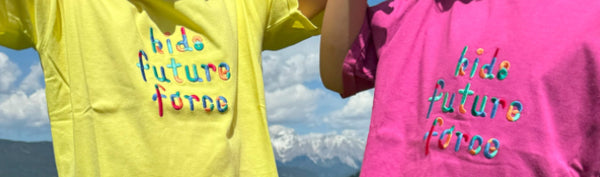
For our new kids' collection, we consciously chose GOTS certification. We underwent the certification process this past summer. This means that we, as a company, are authorized to display the seal on the products in our kids' collection, both on the product packaging and on our website. We believe this will give parents greater peace of mind when buying clothes for their children. However, we have decided not to include the certification in the price of our kids' products, for the benefit of our customers.
Katharina von erlich textil: The "Green Button" label is naturally something we're also interested in. Since the award can only be given to products that already hold recognized certifications (GOTS, etc.), it doesn't offer the customer any clear added value at first glance, in our view. However, if it helps customers decide to buy the "better" product because the label is now more widely known than a GOTS certificate due to media attention, then we certainly welcome that.
Therefore, we are happy to support the German government's initiative to raise public awareness and promote sustainability, fairness, and transparency in the textile industry. This is also why we have decided to begin the certification process. Furthermore, we are aiming for membership in the IVN (International Association of Textile Manufacturers). We believe that, unlike simple quality seals, the networking and exchange among members of the IVN offers a distinct advantage, which will naturally have a positive impact on the entire company.
A purely black-and-white view of the Green Button is, of course, impossible. Voluntary labels are certainly not the only way to ensure sustainable textiles, but they are a good way to enforce and verify certain requirements. And this can ultimately offer consumers added value when shopping, provided they are aware of the conditions of the respective label. For us, however, it is generally necessary to finally develop legal regulations so that fast-fashion giants can no longer evade their responsibility.
Sources:
Federal Ministry for Economic Cooperation and Development (2019). Green Button criteria in detail. Available at: https://www.gruener-knopf.de/kriterien.html (Accessed on 30 September 2019).
German Textile and Fashion Association (2019). German Textile and Fashion Association cannot recommend the Green Button! Available at: https://www.textil-mode.de/en/presse/detailseite/news/gesamtverband-textil-mode-kann-gruenen-knopf-nicht-empfehlen (Accessed on October 1, 2019).
What is the Green Button?
The Green Button is a national quality label for compliance with ecological and social textile standards. What makes it special is that it is the first government-backed label for sustainable textiles and, unlike other labels, combines the two aspects of environmental and social responsibility. A company is assessed against 46 standards and then certified for three years by accredited testing bodies. It is also possible for only individual products within a company to be certified. Furthermore, any company that already holds one of the other recognized labels (such as the GOTS label) can be certified with the Green Button without further assessment.
During the introductory phase, which lasts until June 2021, only the production stages of "cutting and sewing" and "bleaching and dyeing" will initially be inspected. The plan is to cover the entire supply chain and refine the criteria in the coming years. Brands such as Hessnatur, Vaude, as well as Aldi and Tchibo, are already certified.
Don't we already have enough seals of approval?
In principle, every company must bear a certain responsibility in its actions. This responsibility can be enforced either through legal regulations or can also stem from the company's own voluntary commitment. Particularly in the textile sector, there are already a number of different certification labels.But do we really need another label? And how are we supposed to keep track of them all? The Federal Ministry for Economic Cooperation and Development (BMZ) aims to differentiate itself from other labels by presenting the Green Button as a guide that covers all facets of sustainable production.
Of course, as with many other things, there is also criticism of labels. It's difficult to say to what extent labels create transparency, because there are so many labels that it's easy to lose track of all the standards. The German Textile and Fashion Association also considers an additional national label superfluous, as there are already many internationally recognized labels. Furthermore, all labels are voluntary, which means that the responsibility shifts from companies to consumers. Consequently, there are increasing calls for a legally mandated label. It's particularly unfortunate that the Green Button, after a five-year planning phase, contains so little substance. For example, currently only the payment of the respective country's minimum wage is a criterion. This is generally not enough to live on. Actual living wages are only supposed to become a criterion in the coming years.
We also wanted to know what motivates companies to get certified and what their general attitude is towards sustainability labels. To find out, we spoke with two of our partner companies: MELAWEAR and erlich textil.
MELAWEAR has decided to adopt the Green Button as a textile label. Katharina from MELAWEAR answered the following questions for us:
What are your general thoughts on seals of approval and why do you find them useful? What are some perceived disadvantages?
Katharina from MELAWEAR: All our products are certified according to the Global Organic Textile Standard (GOTS) and the Fairtrade Cotton Standard. The cotton is grown in cooperatives with up to 30,000 farmers. How can we in Europe verify that human rights are respected and fair wages are paid in India? How can we ensure that no toxic chemicals are used in dyeing the fabrics? Without standards that are verified on-site by independent auditors, this is very difficult! Even though we maintain close partnerships and good communication with our producers. That's precisely why we at Melawear produce all our products according to GOTS, which prescribes and verifies ecological aspects from cotton cultivation to the packaging of the finished products. In addition, there's the Fairtrade Cotton Standard, which is the only standard that covers social criteria for cotton farmers as well as throughout the entire supply chain.
What are your specific thoughts on the "Green Button" as the first government-backed seal of approval? Especially considering that you are one of the first brands allowed to use this label.
Katharina from MELAWEAR: We firmly believe that the Green Button is a step in the right direction to bring sustainable clothing into the mainstream. We consider any governmental efforts to intervene in the issue of sustainable textile certifications to be important. The Green Button is a kind of meta-label that recognizes and combines many existing standards. It encompasses social and environmental aspects at both the company and product levels. Of course, the Green Button is initially just a minimum standard and will need to become even stricter in the future. We are pleased that we were able to actively participate in the standard's development and are one of the first companies to do so. We are proud that we are the only company to have our entire product range certified according to the Green Button.
Katharina from erlich textil also answered our questions on the topic. Unlike MELAWEAR, they do not (yet) have Green Button certification.
What are your thoughts on sustainability labels? What are the arguments for and against certification?
Katharina von erlich textil: Our producers are GOTS-certified and also hold the Oeko-Tex Standard 100 and BSCI labels. We ourselves are not certified for all the products we sell, as we only sell the certified products and do not process or modify them further. This means that the product would not gain any added value simply because we ourselves were also certified. Certifications are very expensive, and we would have to pass these costs on to the products, which in our view would be an artificial price increase that we would like to avoid.
For our new kids' collection, we consciously chose GOTS certification. We underwent the certification process this past summer. This means that we, as a company, are authorized to display the seal on the products in our kids' collection, both on the product packaging and on our website. We believe this will give parents greater peace of mind when buying clothes for their children. However, we have decided not to include the certification in the price of our kids' products, for the benefit of our customers.
What do you think specifically of the "Green Button" as the first government-issued seal of approval?
Katharina von erlich textil: The "Green Button" label is naturally something we're also interested in. Since the award can only be given to products that already hold recognized certifications (GOTS, etc.), it doesn't offer the customer any clear added value at first glance, in our view. However, if it helps customers decide to buy the "better" product because the label is now more widely known than a GOTS certificate due to media attention, then we certainly welcome that.
Therefore, we are happy to support the German government's initiative to raise public awareness and promote sustainability, fairness, and transparency in the textile industry. This is also why we have decided to begin the certification process. Furthermore, we are aiming for membership in the IVN (International Association of Textile Manufacturers). We believe that, unlike simple quality seals, the networking and exchange among members of the IVN offers a distinct advantage, which will naturally have a positive impact on the entire company.
Our conclusion
A purely black-and-white view of the Green Button is, of course, impossible. Voluntary labels are certainly not the only way to ensure sustainable textiles, but they are a good way to enforce and verify certain requirements. And this can ultimately offer consumers added value when shopping, provided they are aware of the conditions of the respective label. For us, however, it is generally necessary to finally develop legal regulations so that fast-fashion giants can no longer evade their responsibility.
Sources:
Federal Ministry for Economic Cooperation and Development (2019). Green Button criteria in detail. Available at: https://www.gruener-knopf.de/kriterien.html (Accessed on 30 September 2019).
German Textile and Fashion Association (2019). German Textile and Fashion Association cannot recommend the Green Button! Available at: https://www.textil-mode.de/en/presse/detailseite/news/gesamtverband-textil-mode-kann-gruenen-knopf-nicht-empfehlen (Accessed on October 1, 2019).
















Leave a comment
This site is protected by hCaptcha and the hCaptcha Privacy Policy and Terms of Service apply.