


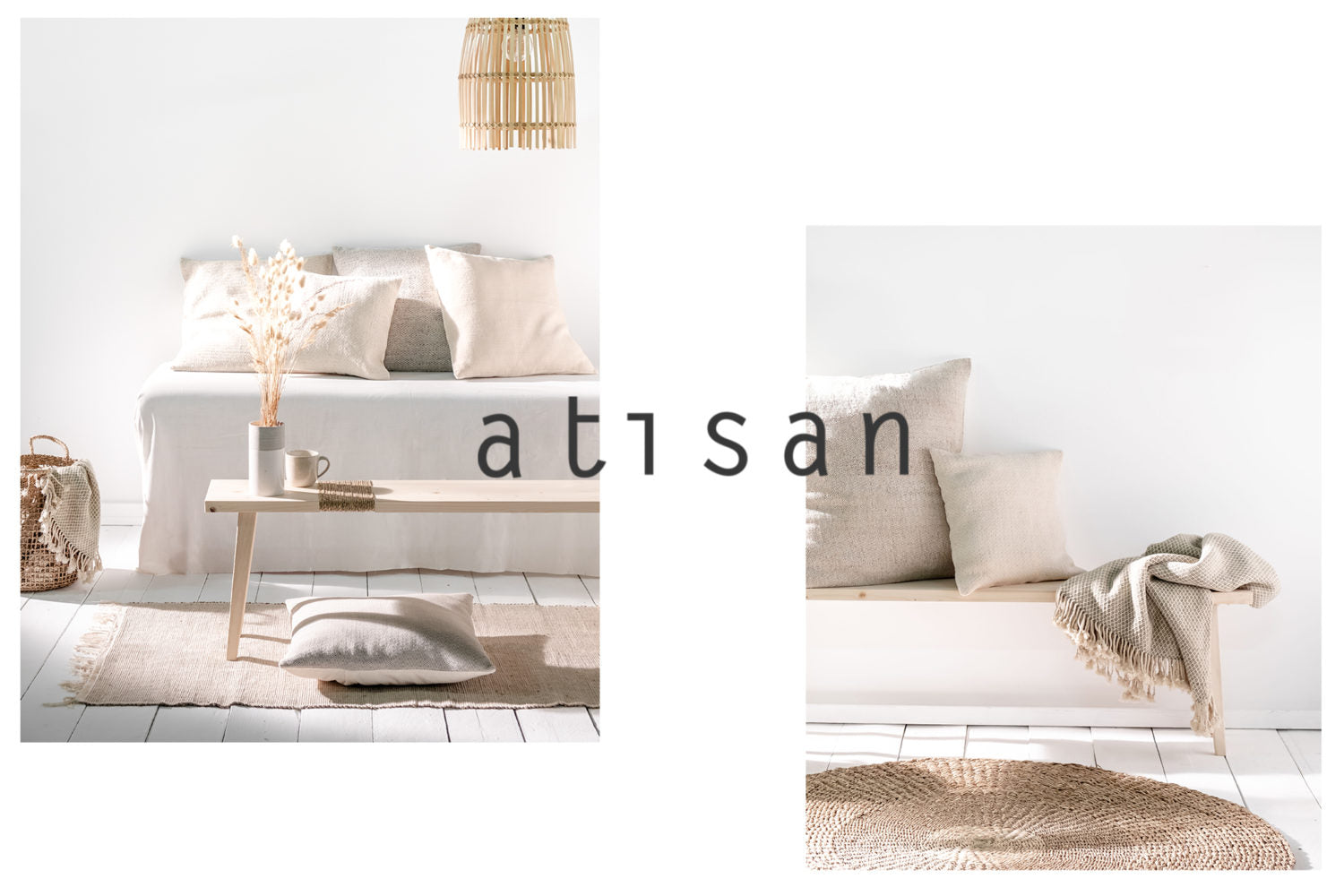
In the fashion and textile sector, there is now a relatively large selection of fair and sustainable alternatives. But what about furniture and interior design? The Düsseldorf-based start-up atisan has made it its mission to offer sustainable alternatives for people who want to change their consumption habits for the better. In this interview, they tell us more about their idea and their product development.
Who is behind atisan and how did your idea come about?
We are Dorka and Daniel from Düsseldorf. Two years ago, we decided to quit our jobs and realize a long-held dream. Now, together with our team, we are working to bring minimalist and natural home accessories made from sustainable materials to the most beautiful place in the world – your own home.
The idea for atisan originated during our travels and solidified further while Daniel was working on an aid project in Kenya. We repeatedly noticed that many countries have talented artisans. They create beautiful, unique pieces, but have limited opportunities to sell them and earn a living.
Furthermore, there is a growing number of people in this country who are questioning their consumption habits and want to live more consciously. The desire to know the origin of the products we consume isn't limited to fashion and food. When we couldn't find an answer to the question "Who made my interior?", we decided to take matters into our own hands and create an alternative.
To that end, in 2017 we embarked on a seven-month journey to find the right partners for our project. Together with talented artisans and fair trade initiatives that make an important contribution to their communities and share our values regarding social and environmental responsibility, we developed our first product line.
How do you define “slow interior”?
Our “slow interior” approach is reflected in many different areas. Because everything we stand for has little to do with speed:
The meticulous manufacturing process of a handmade product.
The long tradition behind it.
Building a close and honest relationship with our partners and ultimately the conscious consumption of interior design and slowing down in one's own home.
We believe that appreciating things that beautify and simplify our lives is an important part of our consumption. In times of mass production and rapidly changing trends, we want to offer an alternative and focus our attention on the value and origin of a handcrafted product.
How are your designs created and where are the products manufactured?
The design of our products usually emerges from a co-creative manufacturing process. This means that, taking into account naturally available resources and traditions, we work together with our manufacturers to develop a product from the initial idea to the finished product. This is often a blend of inspiration, personal taste, and intensive research. At the same time, our close collaboration with our manufacturers allows us to learn a great deal about their craftsmanship and alternative materials, and we incorporate this knowledge into our product selection. In particular, our manufacturers continually inspire us with new ideas for material selection, which we can then use in our products.
What criteria do you use to select your partners, and how does a collaboration typically come about?
A multitude of factors determine which partners we collaborate with: How open is a partner to our questions and visits? What is the atmosphere and cooperation like on-site? Who benefits from profits? How are natural resources managed? What philosophy and values does our partner represent?
In most cases, we conduct on-site research, ask around, and build a network that way. With our products, we place particular emphasis on using materials that originate from the respective regions and have a corresponding tradition there. For example, with our baskets, this means that different regions have different materials, weaving techniques, and patterns. The know-how about processing these materials is passed down through generations.
Regular communication and close collaboration with our partners in the countries of origin are very important to us. We have already met so many talented artisans and want to understand what it means to produce in another country and, above all, to build a relationship with the people who make our products. Therefore, it is essential for us to visit our producers regularly to learn more about their origins, traditions, and natural materials.
How do you manage to offer such high-quality products at relatively low prices?
We work directly with our manufacturers in the countries of origin. We deliberately avoid importers, intermediaries, and wholesalers in order to operate transparently and ensure fair wages and prices.
What is your personal favorite product?
Oh, that's a tough one. Each of our products is unique and has its own story. The Kisi lamp made of seagrass is definitely one of our favorites, as it was developed early on in close collaboration with our partner in Indonesia and quickly became a little 'signature piece' at atisan. Currently, our new textiles from Nepal, especially the cushion covers, are also among our favorites. With this collection, we've discovered many alternative materials, such as banana and nettle fibers, which we're absolutely thrilled about.
Want to take a closer look? Here you'll find our imperfect selection in the shop.





















Leave a comment
This site is protected by hCaptcha and the hCaptcha Privacy Policy and Terms of Service apply.