





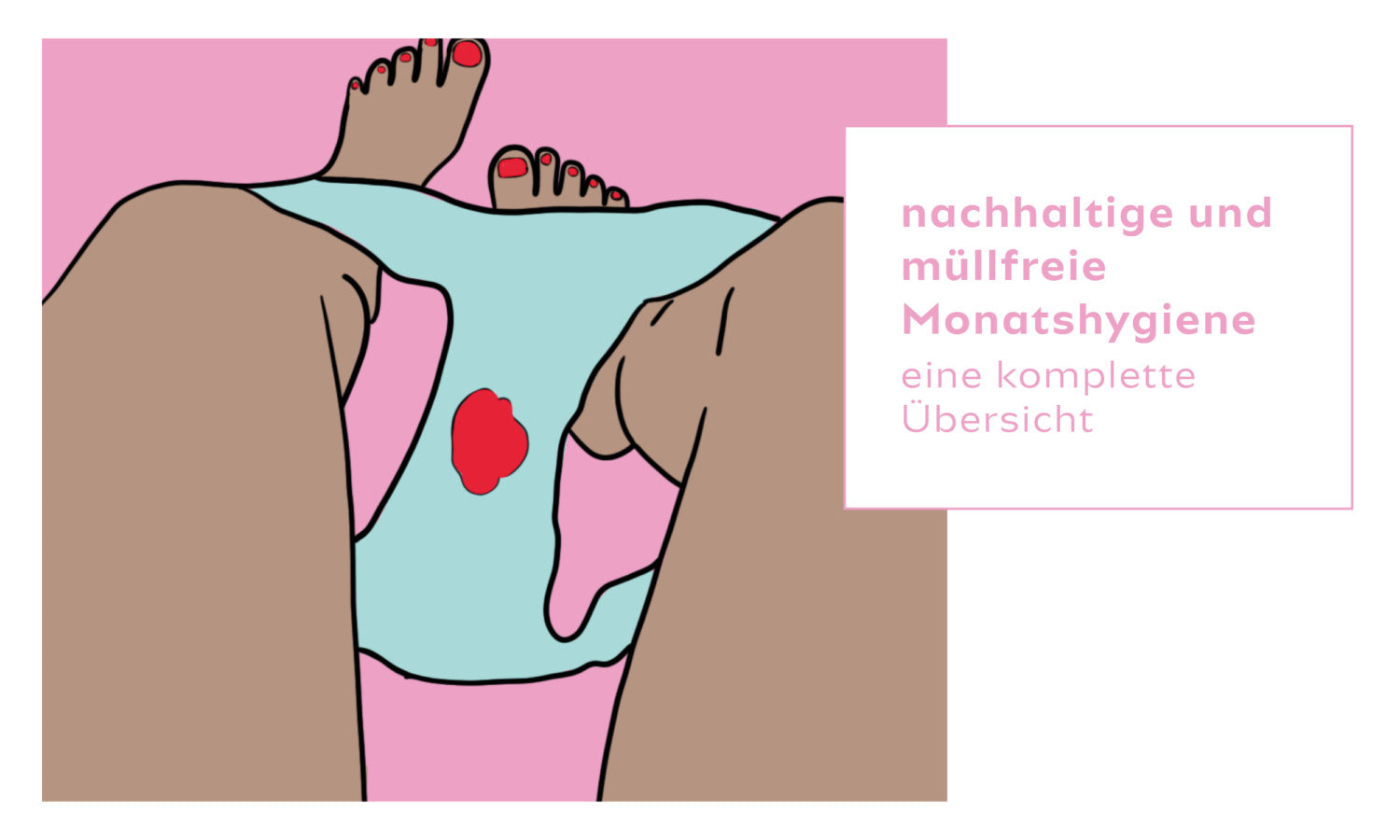
Time for some period talk! It's just blood, right? But is it possible to menstruate without creating waste? Absolutely! And the best part is: just as our periods and cycles vary, so too does the sustainable product mix for periods. But let's start with some hard facts ...
But it's not just the environment that benefits from plastic-free period products – our own bodies also profit significantly! After all, we pay attention to what's in our face cream or our new favorite shampoo – but very few people know what's actually in the hygiene products we apply to our sensitive mucous membranes every month during our period.
You'll be surprised how many different alternatives to tampons or pads now exist. There's sure to be something suitable for you and your period needs!
The menstrual cup isn't actually a new invention; it was designed in the late 1930s, around the same time as tampons. Unfortunately, it didn't really catch on back then, but now it's making a comeback!
Menstrual cups are usually made of medical-grade silicone and come in a wide variety of designs, shapes, and colors. A small selection is now readily available at drugstores. A huge advantage of the menstrual cup is that, with proper care, you can use it for up to 10 years. It has a significantly larger capacity than tampons and is incredibly practical for when you're out and about or playing sports. With a menstrual cup, you can save yourself not only a lot of (plastic) waste and money, but also stress. It's important to carefully consider your body before buying a cup – because you'll only be happy with a cup that fits you perfectly.
When buying a menstrual cup, you should pay attention to the size, the firmness (softness or firmness), and, depending on your preference, the handle for removing it. The right size is crucial to ensure your period cup doesn't slip or cause pain. The right size for you depends less on your height and more on the distance between your vaginal opening and cervix. (You can easily measure this with your fingers.) The heaviness of your flow, your sexual activity, and any previous childbirth also play a role. Phew... quite a few factors to consider, but don't worry, it sounds more complicated than it is!
One thing that's a bit tricky at first is inserting and removing the cup correctly. One tip made all the difference for me: I always run my finger along the rim of the cup to feel if it's covering the cervix and creating a proper seal. There are also different folding techniques for inserting the cup; you just have to experiment a bit.
When removing the cup, it can be helpful to squat down slightly and – very importantly – to release the suction of the menstrual cup beforehand!
I can still remember my own desperate early attempts, when I really wasn't sure if it would work, but now I wouldn't want to be without my menstrual cup for anything. To make yourself feel more secure, you can use a pad or panty liner with it at first.
If you'd like to try a menstrual cup, I've found a detailed guide to help you choose the right one. Click here to see our selection of menstrual cups in our shop!
Depending on whether you want to wear the panties on their own or as a supplement to a menstrual cup or tampons, you'll probably need to buy a whole set, which is a larger initial investment. However, in the medium and long term, period underwear has a similar lifespan to regular underwear and is simply incredibly practical!
If this sounds like an interesting alternative to you, then take a look at the panties in our shop !
Are you generally quite happy with 'normal' sanitary pads, but bothered by the plastic packaging and the sweating? No problem, cloth pads made of organic cotton are the perfect alternative!
Cloth pads are similar in principle to 'normal' pads, only made from (organic) cotton or other natural fibers. Unlike plastic pads, cloth pads are much more breathable and therefore more comfortable to wear. Cloth pads are also available in various absorbencies, sizes, and lengths and need to be changed accordingly. To prevent them from slipping, they usually have snap fasteners on the wings, and to prevent leakage, some cloth pads have a thin plastic layer integrated into the core.
After use, you can rinse the cloth pads – just like period underwear – thoroughly with cold water and then put them in the washing machine with your other clothes. It's always better not to let the cloth pads dry completely, as the blood will then be easier to wash out. The more carefully you care for the cloth pads, the longer they will ultimately last.
Menstrual sponges, also known as Levantine sponges, are, as the name suggests, natural sponges and comparable to soft tampons. They are naturally free of chemicals and other unwanted additives and can be reused for several menstrual cycles.
Before using your menstrual sponge for the first time, soak it in a vinegar and water solution to clean it and neutralize the pH. Afterward, squeeze it out completely and insert it like a regular tampon. Unlike a tampon, it doesn't have a retrieval string, so you should be fine removing it with your fingers. The rest is very straightforward. Depending on the size of the sponge, you'll need to rinse it with cold water regularly, which might be a problem in public restrooms without a sink in the stall. A little tip: Keep a bottle of clean water in your bag for rinsing, just in case. With a menstrual sponge, you definitely have a natural product that doesn't irritate your mucous membranes, is super comfortable to wear, and its soft texture makes it suitable for use during intercourse.
To ensure your sponge lasts as long as possible, wash it thoroughly after your period (never with hot water!) and soak it again in vinegar water. Afterwards, store it in a dry, well-ventilated place, for example in a cotton bag.
And how does it all work? The principle is quite simple: You have to pay close attention to your own body and develop a sense of how often your period starts. As soon as you feel it, head to the toilet. To make sure nothing goes wrong, you should definitely train your pelvic floor muscles well and initially practice at home or with a pad. Once you gradually know your bleeding patterns and everything feels more secure, you can then take short trips outside and see how you manage.
This method naturally saves the most waste. At this point, we are reminded once again what an incredible luxury it is to be able to freely decide whether and which menstrual products we want to use!
If you're really not a fan of the aforementioned menstrual hygiene options, you can, of course, continue using pads or tampons. For the sake of the environment and your body, choose organic pads and tampons: they are made from pure organic cotton, meaning they are produced from plastic-free, biodegradable materials, are free of harmful substances, neither bleached nor perfumed, and therefore won't dry out your mucous membranes. Many organic pads are even no longer packaged in plastic bags, but in an alternative made from cornstarch.
For example, we have MYLILY organic tampons in various sizes in our shop!
We're all as unique as our periods, which is why it makes perfect sense that we all use different products when it comes to menstrual hygiene. A sustainable product that works perfectly for one person might not be the best product for you – and that's perfectly okay! Just do what works for you.
PS: Did you know that not only women can menstruate?
Did you know that a woman* has an average of 450 periods in her lifetime?If we take this calculation a step further, it means that roughly 10,000 to 12,000 tampons are needed in the lifetime of every single menstruating person on this planet! It's quite easy to underestimate the mountains of waste that are actually generated by all these pads and tampons – which is why today we want to take a closer look at the different options for sustainable menstrual hygiene.
But it's not just the environment that benefits from plastic-free period products – our own bodies also profit significantly! After all, we pay attention to what's in our face cream or our new favorite shampoo – but very few people know what's actually in the hygiene products we apply to our sensitive mucous membranes every month during our period.
What different options are there for sustainable menstrual hygiene?
You'll be surprised how many different alternatives to tampons or pads now exist. There's sure to be something suitable for you and your period needs!
Menstrual cup
The menstrual cup isn't actually a new invention; it was designed in the late 1930s, around the same time as tampons. Unfortunately, it didn't really catch on back then, but now it's making a comeback!
Menstrual cups are usually made of medical-grade silicone and come in a wide variety of designs, shapes, and colors. A small selection is now readily available at drugstores. A huge advantage of the menstrual cup is that, with proper care, you can use it for up to 10 years. It has a significantly larger capacity than tampons and is incredibly practical for when you're out and about or playing sports. With a menstrual cup, you can save yourself not only a lot of (plastic) waste and money, but also stress. It's important to carefully consider your body before buying a cup – because you'll only be happy with a cup that fits you perfectly.
When buying a menstrual cup, you should pay attention to the size, the firmness (softness or firmness), and, depending on your preference, the handle for removing it. The right size is crucial to ensure your period cup doesn't slip or cause pain. The right size for you depends less on your height and more on the distance between your vaginal opening and cervix. (You can easily measure this with your fingers.) The heaviness of your flow, your sexual activity, and any previous childbirth also play a role. Phew... quite a few factors to consider, but don't worry, it sounds more complicated than it is!
One thing that's a bit tricky at first is inserting and removing the cup correctly. One tip made all the difference for me: I always run my finger along the rim of the cup to feel if it's covering the cervix and creating a proper seal. There are also different folding techniques for inserting the cup; you just have to experiment a bit.
When removing the cup, it can be helpful to squat down slightly and – very importantly – to release the suction of the menstrual cup beforehand!
I can still remember my own desperate early attempts, when I really wasn't sure if it would work, but now I wouldn't want to be without my menstrual cup for anything. To make yourself feel more secure, you can use a pad or panty liner with it at first.
If you'd like to try a menstrual cup, I've found a detailed guide to help you choose the right one. Click here to see our selection of menstrual cups in our shop!
Period underwear
The principle behind period underwear is similar to that of incontinence wear. This might initially make you think of diapers, but don't worry, these panties are more like sanitary pads – just with an integrated absorbent layer. This means no slipping or pinching – yay! Depending on the model, the panties can absorb the equivalent of one to four regular tampons and, depending on your flow, can be worn for about 12 hours. The fluid is absorbed directly into the absorbent layer, leaving you feeling dry. Different brands use various technologies that provide this comfort and odor protection. After wearing them, you can rinse them with cold (very important!) water and then put them in a mesh laundry bag in the washing machine at 40 degrees Celsius (of course, you should always follow the manufacturer's instructions first).Depending on whether you want to wear the panties on their own or as a supplement to a menstrual cup or tampons, you'll probably need to buy a whole set, which is a larger initial investment. However, in the medium and long term, period underwear has a similar lifespan to regular underwear and is simply incredibly practical!
If this sounds like an interesting alternative to you, then take a look at the panties in our shop !
Cloth pads
Are you generally quite happy with 'normal' sanitary pads, but bothered by the plastic packaging and the sweating? No problem, cloth pads made of organic cotton are the perfect alternative!
Cloth pads are similar in principle to 'normal' pads, only made from (organic) cotton or other natural fibers. Unlike plastic pads, cloth pads are much more breathable and therefore more comfortable to wear. Cloth pads are also available in various absorbencies, sizes, and lengths and need to be changed accordingly. To prevent them from slipping, they usually have snap fasteners on the wings, and to prevent leakage, some cloth pads have a thin plastic layer integrated into the core.
After use, you can rinse the cloth pads – just like period underwear – thoroughly with cold water and then put them in the washing machine with your other clothes. It's always better not to let the cloth pads dry completely, as the blood will then be easier to wash out. The more carefully you care for the cloth pads, the longer they will ultimately last.
Menstrual sponge
Menstrual sponges, also known as Levantine sponges, are, as the name suggests, natural sponges and comparable to soft tampons. They are naturally free of chemicals and other unwanted additives and can be reused for several menstrual cycles.
Before using your menstrual sponge for the first time, soak it in a vinegar and water solution to clean it and neutralize the pH. Afterward, squeeze it out completely and insert it like a regular tampon. Unlike a tampon, it doesn't have a retrieval string, so you should be fine removing it with your fingers. The rest is very straightforward. Depending on the size of the sponge, you'll need to rinse it with cold water regularly, which might be a problem in public restrooms without a sink in the stall. A little tip: Keep a bottle of clean water in your bag for rinsing, just in case. With a menstrual sponge, you definitely have a natural product that doesn't irritate your mucous membranes, is super comfortable to wear, and its soft texture makes it suitable for use during intercourse.
To ensure your sponge lasts as long as possible, wash it thoroughly after your period (never with hot water!) and soak it again in vinegar water. Afterwards, store it in a dry, well-ventilated place, for example in a cotton bag.
Free Bleeding
This new trend probably isn't for everyone, because free bleeding involves simply letting the blood flow freely without using any period products. It's perfect for people who are reluctant to use foreign objects, don't tolerate them well, or simply want to get to know their body and their own menstrual cycle completely.And how does it all work? The principle is quite simple: You have to pay close attention to your own body and develop a sense of how often your period starts. As soon as you feel it, head to the toilet. To make sure nothing goes wrong, you should definitely train your pelvic floor muscles well and initially practice at home or with a pad. Once you gradually know your bleeding patterns and everything feels more secure, you can then take short trips outside and see how you manage.
This method naturally saves the most waste. At this point, we are reminded once again what an incredible luxury it is to be able to freely decide whether and which menstrual products we want to use!
Organic tampons & organic sanitary pads
If you're really not a fan of the aforementioned menstrual hygiene options, you can, of course, continue using pads or tampons. For the sake of the environment and your body, choose organic pads and tampons: they are made from pure organic cotton, meaning they are produced from plastic-free, biodegradable materials, are free of harmful substances, neither bleached nor perfumed, and therefore won't dry out your mucous membranes. Many organic pads are even no longer packaged in plastic bags, but in an alternative made from cornstarch.
For example, we have MYLILY organic tampons in various sizes in our shop!
But what is the best alternative?
The answer to this question is: The best alternative is the one YOU feel most comfortable with! Personally, I've found a solution that works for me with a combination of a menstrual cup and period underwear. On heavy flow days, I have double protection, and on lighter days, the underwear is perfectly sufficient, and I don't have to worry about potential leaks. And hey, leaks are perfectly normal – it's just blood, after all!We're all as unique as our periods, which is why it makes perfect sense that we all use different products when it comes to menstrual hygiene. A sustainable product that works perfectly for one person might not be the best product for you – and that's perfectly okay! Just do what works for you.
PS: Did you know that not only women can menstruate?



















Leave a comment
This site is protected by hCaptcha and the hCaptcha Privacy Policy and Terms of Service apply.