

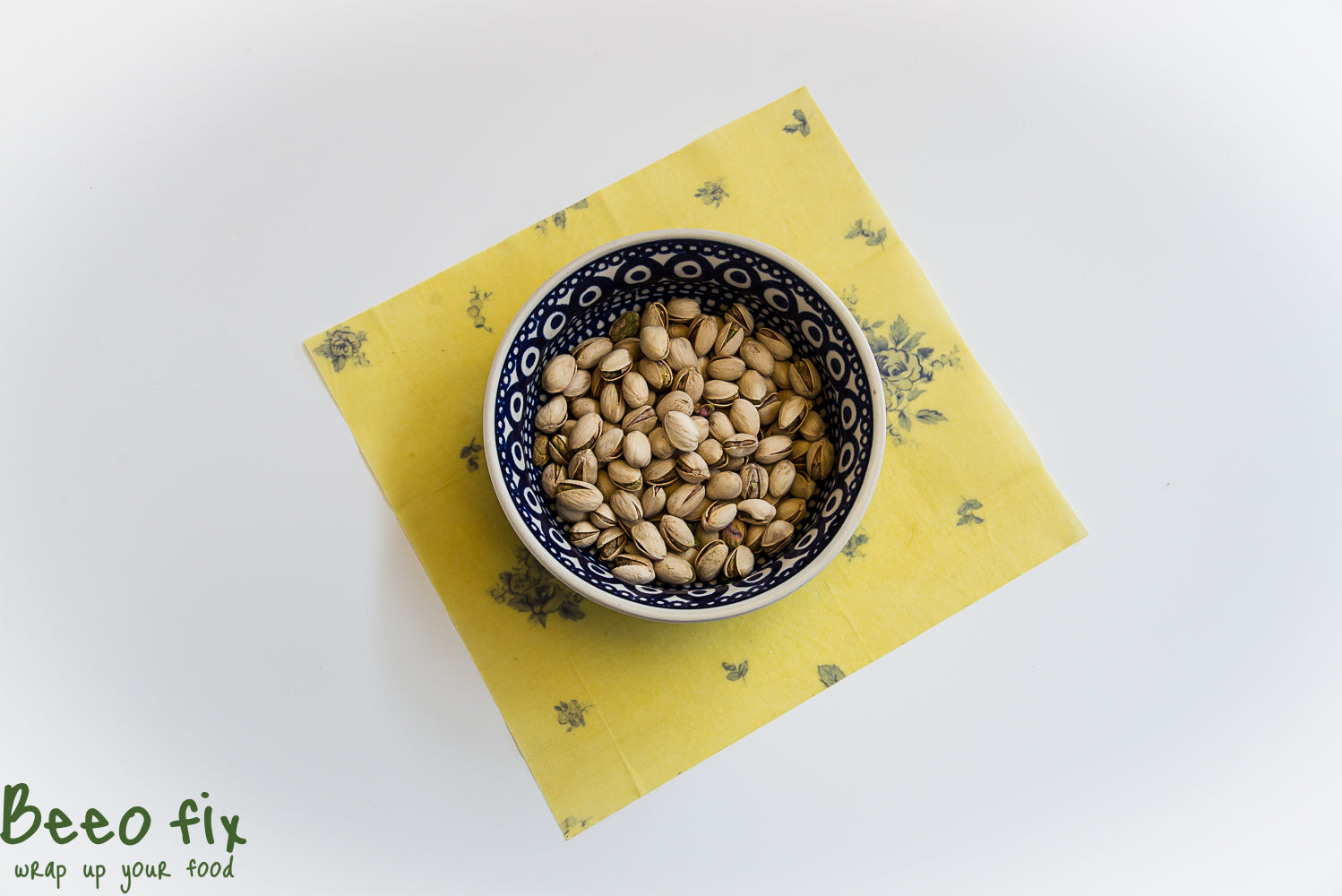
Especially in the kitchen, a lot of waste and packaging accumulates. But it doesn't have to be that way. In Lower Austria, Christa and her company Beeofix produce upcycled beeswax wraps that are guaranteed to make your kitchen waste-free and serve as practical everyday helpers. You can find out exactly how to use beeswax wraps and why they are a wonderful alternative to aluminum foil and plastic wrap in the interview I conducted with Christa. And of course, there are also a few imperfect beeswax wraps available here in the shop ;-)
The idea came to me about three years ago when I received a beeswax wrap as a gift. It was an American product, and I really liked it for my household. I found it practical, and its reusability convinced me. Reducing waste has always been important to me. Since I couldn't justify ordering more wraps from America, I started experimenting. Finally, after several attempts, a broken iron, and many wax and resin stains, I found a suitable recipe and was satisfied. I had homemade beeswax wraps. Convinced of their effectiveness, I started producing more and gave them away as gifts, for example, as party favors or birthday presents to friends and acquaintances. Because they were always so well-received, I decided—after a trial sale at the weekly market in Waidhofen an der Ybbs—to start a business and sell my beeswax wraps.
After reports in regional media, I was repeatedly asked to create an online shop. So, I simply did it. And that was a good thing, because it meant my beeswax wraps could be ordered outside the region as well.
Beeofix beeswax wraps are an upcycled product because they are made from used, well-preserved cotton and linen fabrics (washed and disinfected). The reason for using secondhand fabrics is simply that waste reduction and environmental protection are very important to me. Why produce and print new fabrics when there are plenty of others available?
The zero-waste concept runs through the entire Beeofix project:
It was actually quite simple: the name had to include bees, hence "Bee," and since I only use organic raw materials, I added the "O," killing two birds with one stone: the bees and the organic quality. "Fix" indicates that the wipes are self-adhesive. Finally, the brand name should sound good and roll off the tongue, and "Beeofix" certainly does.
Beeswax is produced in the wax glands of bees and secreted into the bee's abdominal pouch. There it hardens into a tiny white platelet. The bee uses its hind legs to remove it from this pouch and pass it to its front mandibles. There, it is chewed with pollen oil into pliable, yellow balls and finally used to build honeycomb/wax cells.
Only regional beeswax of certified organic quality is used in the production of Beeofix beeswax wraps.
So what does an organic beekeeper do differently? Bees aren't pets; they're wild animals and would therefore always do everything "right." Humans have caused bees significant problems over many years through conventional beekeeping practices: bee pests, bacteria, and the Varroa mite. Conventional beekeepers use chemicals and medications, for example, which leave residues in the hives, wax, and propolis for many years. An organic beekeeper's natural beekeeping methods are based on the bees' natural needs. There are specific guidelines for certified organic beekeeping that must be followed. These guidelines primarily focus on the bees. However, they are also crucial for the product quality of honey, beeswax, and propolis.
Beeofix is a reusable and resource-saving alternative to aluminum and plastic foils.
To answer this question very quickly: Treat it like a plate or other storage container, with the only difference being: Use cold water.
Beeswax wrap KEY FACTS:
- Reusable and resource-saving alternative to aluminum and plastic foil for wrapping food
- Washable with cold (at most lukewarm) water and possibly a little dish soap, and reusable many times.
- Zero Waste (compostable)
- Consisting of cotton fabrics, beeswax, jojoba oil and resin
1. Dear Christa, how did you come up with the idea of making beeswax wraps and selling them in your own online shop? And why is Beeofix an upcycled product?
The idea came to me about three years ago when I received a beeswax wrap as a gift. It was an American product, and I really liked it for my household. I found it practical, and its reusability convinced me. Reducing waste has always been important to me. Since I couldn't justify ordering more wraps from America, I started experimenting. Finally, after several attempts, a broken iron, and many wax and resin stains, I found a suitable recipe and was satisfied. I had homemade beeswax wraps. Convinced of their effectiveness, I started producing more and gave them away as gifts, for example, as party favors or birthday presents to friends and acquaintances. Because they were always so well-received, I decided—after a trial sale at the weekly market in Waidhofen an der Ybbs—to start a business and sell my beeswax wraps.
After reports in regional media, I was repeatedly asked to create an online shop. So, I simply did it. And that was a good thing, because it meant my beeswax wraps could be ordered outside the region as well.
Beeofix beeswax wraps are an upcycled product because they are made from used, well-preserved cotton and linen fabrics (washed and disinfected). The reason for using secondhand fabrics is simply that waste reduction and environmental protection are very important to me. Why produce and print new fabrics when there are plenty of others available?
The zero-waste concept runs through the entire Beeofix project:
- Upcycling used cotton or linen fabrics
- Avoidance of waste, as Beeofix beeswax wraps are reusable and do not need to be disposed of after a single use like conventional aluminum or plastic cling film.
- Food lasts longer due to the slightly biocidal effect of beeswax and tree resin.
- Firelighters for grilling or fireplaces are made from production waste.
Beeofix is handmade from upcycled cotton fabrics, regional organic beeswax, organic jojoba oil and tree resin from Lower Austria.
2. How did you come up with the company name "Beeofix"?
It was actually quite simple: the name had to include bees, hence "Bee," and since I only use organic raw materials, I added the "O," killing two birds with one stone: the bees and the organic quality. "Fix" indicates that the wipes are self-adhesive. Finally, the brand name should sound good and roll off the tongue, and "Beeofix" certainly does.
Beeofix is reusable, breathable, plastic-free, compostable, and an upcycled product.
3. What exactly is beeswax? How is it obtained, and are there differences in terms of sustainability and the welfare of the bees?
Beeswax is produced in the wax glands of bees and secreted into the bee's abdominal pouch. There it hardens into a tiny white platelet. The bee uses its hind legs to remove it from this pouch and pass it to its front mandibles. There, it is chewed with pollen oil into pliable, yellow balls and finally used to build honeycomb/wax cells.
Only regional beeswax of certified organic quality is used in the production of Beeofix beeswax wraps.
So what does an organic beekeeper do differently? Bees aren't pets; they're wild animals and would therefore always do everything "right." Humans have caused bees significant problems over many years through conventional beekeeping practices: bee pests, bacteria, and the Varroa mite. Conventional beekeepers use chemicals and medications, for example, which leave residues in the hives, wax, and propolis for many years. An organic beekeeper's natural beekeeping methods are based on the bees' natural needs. There are specific guidelines for certified organic beekeeping that must be followed. These guidelines primarily focus on the bees. However, they are also crucial for the product quality of honey, beeswax, and propolis.
Beeofix upcycled beeswax wraps are soaked with organic beeswax, organic jojoba oil and tree resin to give them the desirable and practical properties of other cling films.
4. How can I use a beeswax wrap in everyday life? What are some possible uses?
Beeofix is a reusable and resource-saving alternative to aluminum and plastic foils.
- Cover containers with bread, cheese, fruit or vegetables with Beeofix.
- Seal a bowl with Beeofix.
- Beeofix is also suitable as a lid for yogurt cups.
- Beeofix adapts to the warmth of the hands of any shape, seals breathablely and has a mild biocidal effect.
- Raw meat or fish should not come into contact with Beeofix beeswax wraps.
5. How do I care for my beeswax wrap and when do I need to dispose of it?
To answer this question very quickly: Treat it like a plate or other storage container, with the only difference being: Use cold water.
- Beeofix cloths can be cleaned after use under running water ranging from cold to a maximum of 25°C. You can also use a little dish soap for cleaning. (Water and dish soap will bead up on the Beeofix cloths, just like on a plate.)
- Beeofix wipes are best stored in a cool, dry place.
- Beeofix wipes cannot tolerate hot water, sunlight, radiators, microwaves, or cleaning in washing machines or dishwashers!
- One last tip: If your Beeofix beeswax wrap ever starts to look a little less fresh (creases are normal), place it between two sheets of parchment paper, like the kind you use for baking cakes, and iron over the top sheet. You'll see, it will look like new again, and the heat will also kill any germs that might be present. Normally, however, germs aren't a problem, as beeswax and tree resin have a mild biocidal effect.
- With careful handling, you can use your Beeofix beeswax wrap approximately 100 times. This corresponds to a lifespan of about one year.
- Beeofix is not a miracle cloth and food stored with it should be consumed in a timely manner.
If your Beeofix beeswax wrap develops mold spots (because bowls covered with it were hidden at the very back of the refrigerator and were only discovered much too late), you can no longer use it. - At the end of its lifespan, you can return your Beeofix beeswax wrap to nature: they are compostable. Alternatively, use them as firelighters for grilling or for kindling in your fireplace.



















Leave a comment
This site is protected by hCaptcha and the hCaptcha Privacy Policy and Terms of Service apply.