

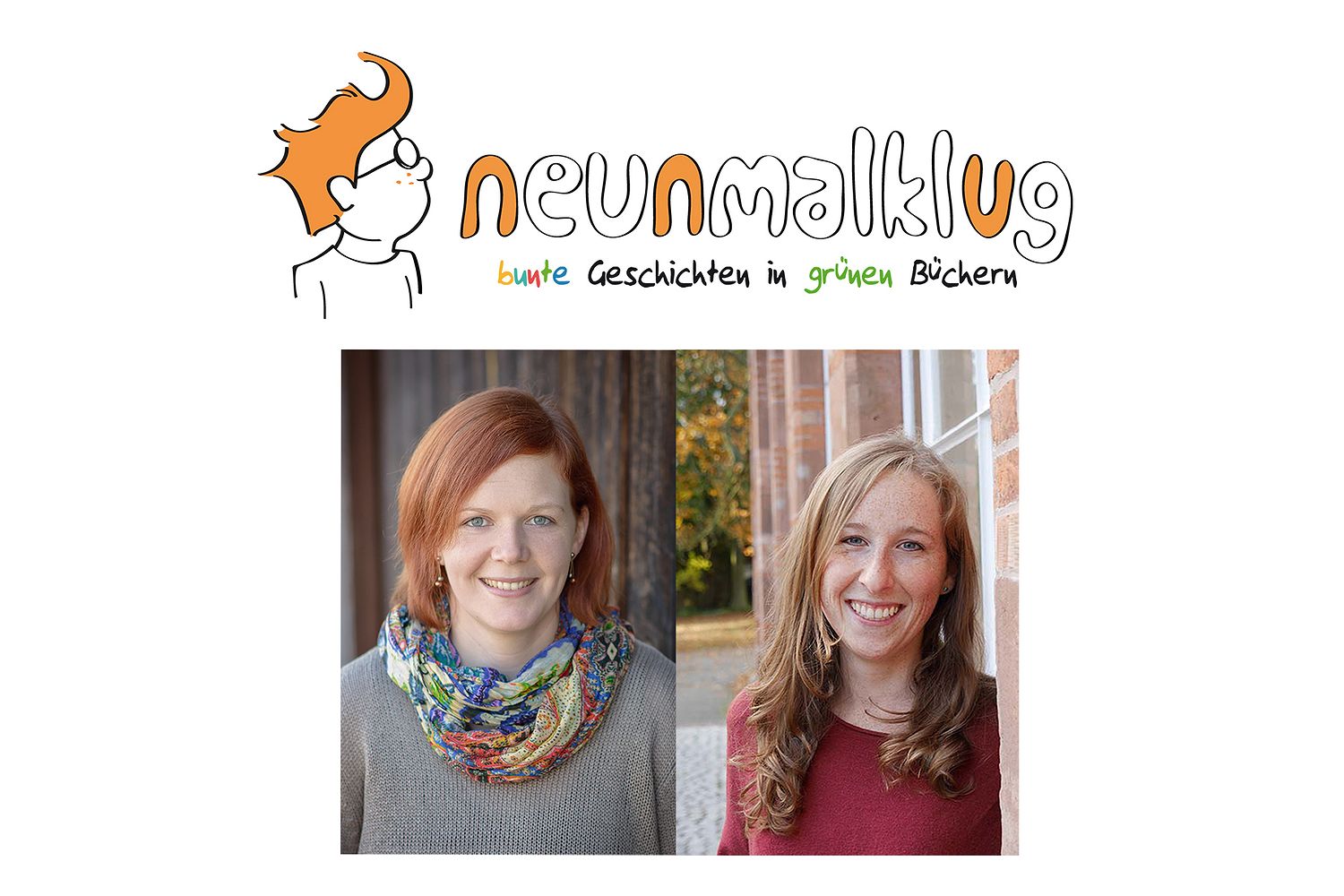
How sustainable are children's books, really, and can they be made more sustainable so that they are safe for children? Charlotte Stiefel, founder of neunmalklug Verlag , asked herself this question when she founded the first German children's book publisher to print books according to the Cradle to Cradle concept in 2014. She explains what this means in an interview she and her publishing partner Sarah Roller conducted with us.
I (Charlotte) founded the children's book publishing house back in 2014 because sustainability has long been a passion of mine. I want to produce only books that children can explore with all their senses, without ingesting any toxic substances. That's why, from the very beginning, only printing according to the Cradle to Cradle concept was an option for me.
In 2015, we published the world's first board books, "Come, let's get closer!", developed in collaboration with the printing company gugler and printed according to this principle. Sarah had the idea for the short stories for children from 12 months old and wrote the rhymes for them.
Since August 2017, Sarah has also been a publisher at neunmalklug. She primarily supports me in the areas of editing and program planning. We met a few years ago while studying Media Publishing in Stuttgart.
We are both mothers now, which is why environmentally and health-friendly products have become even more important to us.
I admit, it's a bit crazy. But we both believe that printed picture books aren't going anywhere. Especially with toddlers, we find it unimaginable to read aloud purely digitally. When I decided in 2013 to build something of my own to make the world a slightly better place, I kept coming back to bookmaking. After all, I'm a bookseller, I studied publishing, and I'd already noticed the lack of sustainability in that field. So I just took the plunge. Back then, my Cradle to Cradle concept was unique, and I'd found a niche.
Unfortunately, the printing inks, paper, varnishes, and foil used for picture books far too often contain substances unsuitable for small children, as these books are frequently put in their mouths. Most book buyers are unaware of bisphenol A, VOCs, CMRs, and mineral oils in the printing inks and how harmful these substances are. Furthermore, over half of all picture books are printed in Asia and shipped across the oceans in container ships, which pollute the environment and harm human health with sulfur dioxide and nitrogen oxides.
While more and more publishers now offer books made with recycled paper and vegetable oil inks, recycled paper contains all the harmful substances found in conventional printed products.
Click here to go to the website of neunmalklug-Verlag!
1. Who is behind neunmalklug Verlag and what distinguishes you from ordinary publishers?
We are Charlotte Stiefel and Sarah Roller, and we are the two publishers of neunmalklug.I (Charlotte) founded the children's book publishing house back in 2014 because sustainability has long been a passion of mine. I want to produce only books that children can explore with all their senses, without ingesting any toxic substances. That's why, from the very beginning, only printing according to the Cradle to Cradle concept was an option for me.
In 2015, we published the world's first board books, "Come, let's get closer!", developed in collaboration with the printing company gugler and printed according to this principle. Sarah had the idea for the short stories for children from 12 months old and wrote the rhymes for them.
Since August 2017, Sarah has also been a publisher at neunmalklug. She primarily supports me in the areas of editing and program planning. We met a few years ago while studying Media Publishing in Stuttgart.
We are both mothers now, which is why environmentally and health-friendly products have become even more important to us.
Our neunmalklug books are made exclusively from materials that can be returned to the biological cycle. The paper comes from certified forests and is printed with vegetable oil inks. The books are produced exclusively in Germany and Austria (neunmalklug Verlag website).
2. These days, so much takes place in the digital world. So why choose to start a publishing house? What motivated you?
I admit, it's a bit crazy. But we both believe that printed picture books aren't going anywhere. Especially with toddlers, we find it unimaginable to read aloud purely digitally. When I decided in 2013 to build something of my own to make the world a slightly better place, I kept coming back to bookmaking. After all, I'm a bookseller, I studied publishing, and I'd already noticed the lack of sustainability in that field. So I just took the plunge. Back then, my Cradle to Cradle concept was unique, and I'd found a niche.
3. Topic: Sustainability in the book world: How sustainable is the conventional book industry? Does sustainability already play an important role there?
Unfortunately, the printing inks, paper, varnishes, and foil used for picture books far too often contain substances unsuitable for small children, as these books are frequently put in their mouths. Most book buyers are unaware of bisphenol A, VOCs, CMRs, and mineral oils in the printing inks and how harmful these substances are. Furthermore, over half of all picture books are printed in Asia and shipped across the oceans in container ships, which pollute the environment and harm human health with sulfur dioxide and nitrogen oxides.
While more and more publishers now offer books made with recycled paper and vegetable oil inks, recycled paper contains all the harmful substances found in conventional printed products.
4. Your books are all Cradle to Cradle certified. Could you briefly explain the term and what it means?
Cradle to Cradle is an English term that translates to "from cradle to cradle." The Cradle to Cradle concept generates no waste. All materials used can be reused in closed-loop systems. For our books, this means that the residual materials from recycling can be safely returned to nature and do not need to be incinerated as toxic waste. This makes our children's books ideal for both people and the environment.Cradle to Cradle (C2C) translates to "from cradle to cradle." This means that once our books have served their purpose, they can be returned to the biological cycle – they are compostable without leaving behind any harmful substances. This allows new trees to grow (neunmalklug Verlag website).
5. How future-proof do you think the principle of the circular economy is, since it's the core principle of your publishing house? Do you think it will prevail in our society in the long term?
We certainly hope so, because we see it as the only solution for our planet. No other living being produces waste and destroys its own habitat. While abstinence and reduction also play an important role, in the long term we need to completely change our economic system, and that is only possible with a circular economy.Click here to go to the website of neunmalklug-Verlag!


















Leave a comment
This site is protected by hCaptcha and the hCaptcha Privacy Policy and Terms of Service apply.